Communication and Leadership Resources
The list of topics and concepts below is not a comprehensive list, but these are just some of the principles that guide our work within the Communication & Leadership area of CSI. Please reach out to ccl@ucsd.edu if you would like a consultation with one of our team members as to how we may advance the development of individuals or teams.
Please note that for the 2025-26 academic year, the CSI - Communication & Leadership team has identified the following learning goals:
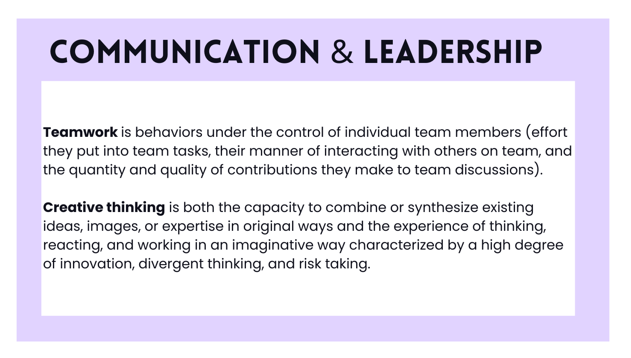
These goals drive our program assessment are taken from the Teamwork and Creative Thinking AACU Rubrics.
Resources for Building Communication Skills
Intrapersonal Communication is the inner communication within oneself. It can be hard to understand or define, but Barker and Wiseman defined intrapersonal communication as “the creating, functioning, and evaluating of symbolic processes which operate primarily within oneself.”2 The researchers go on to explain that intrapersonal communication exists on a continuum from thinking and reflecting (more internal) to talking aloud or writing a note to one’s self (more external).
In order to be able to communicate effectively it is imperative to better understand how self-concept, self-esteem, and perception play a role in how we see ourselves. Once we better understand our needs, preferences, and styles we then can better understand how to communicate with others.
There are multiple different communication and learning styles. The most common communication styles are: passive, aggressive, passive aggressive, and assertive. In addition to understanding how you communicate under different circumstances it is imperative to reflect on how you learn. The four most common learning styles are auditory, visual, reading/writing, and kinesthetic. Aside from these styles you should also consider the following factors inherent in building strong communication skills:
- Needs - Each individual has needs. Although we may not be great at articulating our needs, thankfully Abraham Maslow studied motivation theory and categorized human needs into what is commonly known as Maslow’s Hierarchy of Needs. Remember, this image depicts the findings and broad categories of human needs and each plays a critical role in surviving and thriving.
- Stress & Performance - Stress plays a critical role in our day to day lives. Stress often impacts our ability to perform tasks in both positive and negative ways. To better understand the impact of stress on performance you can reference the Yerkes Dodson law or review the image below:
It is important to understand the amount of arousal or stress needed to create optimal performance. This may look different for everyone, but reflect on some of your recent experiences for examples of what optimal performance looks like for you.
- Transition - Transitions are often some of the most difficult times in our lives filled with uncertainty, new experiences, and even rejection. Thankfully there is a higher education researcher named Nancy Schlossberg who studied transition and developed a Transition Theory. Understanding the type of transition and how you cope with these changes to your life is critical. Schlossberg identified four factors that are critical to a successful transition: situation, self, social support, and strategies. Use the link above to learn more and reflect on transitions that you have encountered and experienced in your own life.
In addition to the theories described above, how you learn about yourself is a process. You will need a strong sense of self awareness and the ability to articulate about yourself. Self awareness is defined as… Additionally, how you learn about yourself and the thoughts, ideas, and beliefs that you hold derives from your culture and how you were socialized.
- Culture - In the 1970s Edward Hall explained culture as an iceberg. The iceberg model of culture illustrates that only about 10% of one’s culture is visible at a time leaving about 90% hidden. Often some topics and aspects of our culture are showing at the top of the iceberg, but our most deeply held styles, rules, and beliefs are often hidden beneath the surface. This analogy is still used today as a good way to understand the complexities of culture and human behavior.
- Cycle of Socialization - Another way to explain the process in which we come to know and explain the world is called the cycle of socialization. This model was developed by Bobbie Harro in the early 2000s to better explain how we are socialized from birth. The model details how institutions and culture shape who we become. Certain messages get reinforced, while others are challenged resulting in reinforcing certain notions or creating change.
- Identity - Your culture, values, and beliefs are a part of who you are. One way in which we explain aspects of who we are is through our identities. The identity wheel below showcases the most common aspects of our personal and social identities.
- Another way to conceptualize and visualize our identities is through the multiple dimensions of identity. This model adds context as depicted and explained in the cycle of socialization and maps it onto our identity. It also shows how certain aspects of our identity may be more salient as we move through different stages of our lives.
Beyond identity, a powerful tool that you can use to learn about yourself is personality assessments. Each assessment uses different models and theories based in psychology to better explain aspects of our personalities. Some of the most common personality assessments are True Colors, Myers Briggs, and CliftonStrengths. Again, the CSI Communication & Leadership team can lead specialized workshops on the topics above to help you better understand yourself, which will in turn help you better understand others.
Interpersonal Communication describes the communication between people. Below are some common principles that aid in strong interpersonal communication.
- Building relationships - There is a specific way in which relationships are formed and Mark Knapp developed a Relationship Model. This model explains the process in which deep relationships are formed and also how relationships can come apart.
- Understanding and Addressing Conflict - Conflict is inevitable when working with others. By better understanding our natural response to conflict we can become better at addressing conflict when it arises. In 2003, Mitch Hammer published a Model of Intercultural Conflict Styles that details how our communication styles and emotions impact how we respond to conflict.
Dialogue and Facilitation
- Dialogue is a critical component in moving towards understanding. There are multiple forms of dialogue programs at UC San Diego that can provide training and support to enhance productive dialogue. Check out Dialogue for Peace and the Dialogue Across Difference initiatives for more information. UC San Diego also utilizes peacemaking and restorative justice to build community, increase accountability and strengthen community. Often this will entail creating circles to discuss our values and create trust through different forms of storytelling.
- In order to create an engaging experiential learning environment where everyone feels welcomed and comfortable, Brooks-Harris & Stock-Ward detailed four facilitation stages, which are engaging, informing, involving, and planning.
Often communication will involve speaking in front of others. Whether this is a large crowd or a small gathering, public speaking is something that you will encounter. It is important to note that both what we say and how we say it are important in communicating our message. The research of Albert Mehrabian explains how the verbal, vocal, and visual cues must be in alignment for our message to be understood. Be sure to explore your verbal and nonverbal behaviors to better understand their impact on how you communicate.
Resources for Building Leadership Skills
There are multiple different leadership frameworks that can help guide how we work with others.
- One of the most prominent and frequently cited models in higher education is the Leadership for Social Change Model. This model was developed by Helen and Alexander Astin and explored how to make lasting, positive social change even when one may not hold a “traditional leadership role”. This model sees leadership as a collaborative process that encompasses 7 values (which is sometimes referred to as the 7 Cs since each value starts with the letter C).
- Another common leadership theory is Servant Leadership which was developed by Robert Greenleaf in the late 1970s. This model puts the needs and wants of one’s followers above your own. Servant Leadership challenges the top-down style of leadership and empowers leaders to develop other people’s potential. Work on this model continued in the 1990s with Larry Spears addition of 10 servant leadership characteristics, all of which contribute to the ultimate goal of serving others above oneself.
- The Leadership Identity Model is based on the work of Komives et al. in the mid 2000s to explore how people come to see themselves as leaders. This model outlines 6 different stages: awareness, exploration/engagement, leader identified, leadership differentiated, generativity, and integration/synthesis. Each stage is marked by a transition that empowers the individual to take action and better identify what it means to be a leader. While the stages are represented linearly, they are cyclical and can be visualized as a helix with the ultimate goal of helping individuals understand their own, unique identity as a leader.
The three frameworks described above are common leadership theories used in higher education, however it should be noted that leadership does not happen alone. Teamwork is an essential component in working with others. One way to lead others effectively is to utilize an asset based framework. One of these frameworks is the Gallup StrengthsFinder assessment that was developed by Donald Clifton. This assessment is based on positive psychology and focuses on what talents come naturally to individuals. Then these talents are developed into strengths. Those who utilize their strengths tend to be more engaged and report higher satisfaction than those who are managed in other ways.
When thinking about teamwork, it is important to know that there is a specific process that explains how groups form. This is known as the Tuckman’s Stages of Group Development. In the mid 1960s Bruce Tuckman described the following stages of group formation: forming, storming, norming, performing. There are important markers for each stage and steps that must be completed for your group to advance to the next stage.
Another critical component of teamwork is mattering. Think back to Maslow’s hierarchy of needs. At the top of the pyramid is self-actualization, esteem, love and belonging. In order for team members to be invested in accomplishing their individual or group goals, they must feel like they matter. Nancy Schlossberg developed the Theory of Mattering. This theory directly applies to how individuals are supported by institutions and is predicated by attention, importance, ego-extension, dependence, and appreciation. The concept of mattering is in contrast to marginalization. Just as we must examine the cues, feelings, and actions that let us know that we matter, we must also recognize the cues, feelings, and actions that make people feel as if they do not.
Prop 209 Compliance
In accordance with applicable Federal and State law and University policy, the University of California does not discriminate, or grant preferences, on the basis of race, color, national origin, religion, sex, disability, and/or other protected categories.
More information about .
More information about the
CSI: Communication & Leadership
Phone: (858) 534-0501
Email: ccl@ucsd.edu
Location: Price Center East, level 3 (map)
Mailing Address: 9500 Gilman Drive #0078
La Jolla, CA 92093-0078